
By: Vaishnavi Goboodun, Fellow 2023, YABT
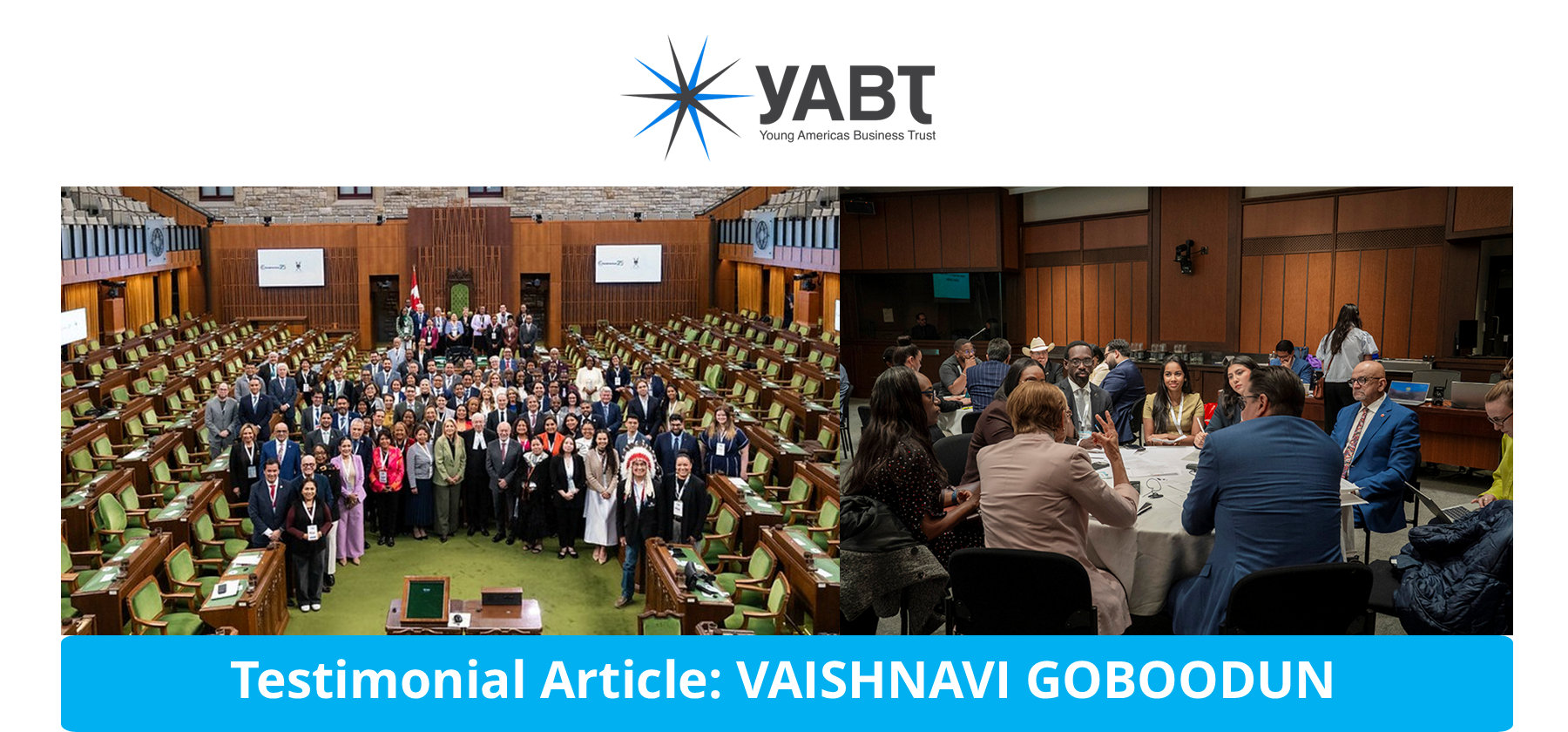
I had the privilege to attend the 22nd ParlAmericas Plenary Assembly and 10th Gathering of the Open Parliament Network which was held from May 19 to 22, 2026 in Ottawa, Canada. The Assembly brought together parliamentarians, experts, and youth delegates from across the Americas to examine parliamentary leadership on trade, innovation, and security in a rapidly shifting geopolitical and economic landscape.
I am honored to have been nominated by the Young Americas Business Trust as a youth delegate and to have had the opportunity to spend four days at the heart of some of the most important conversations shaping the Americas, engaging with leaders on democracy, economic development, and the future of work. The youth delegates I met and collaborated with were among the highlights of the entire experience. Diverse in background and area of focus, yet united by a shared sense of purpose, their perspectives challenged and sharpened my thinking about regional issues.
On May 22, 2026, I participated as a reporter in the Youth led Visions for Inclusive Economic Transitions session, part of the broader dialogue on Sustainable Futures: Youth Perspectives on the Future of Work and the Economy. I had the opportunity to lead a session on inclusive policy and artificial intelligence, where I presented my vision statement, raised critical questions, and guided the roundtable discussion. The session began with a roundtable exchange in which parliamentarians and experts spoke openly from their own national contexts, sharing real world insights that set a collaborative foundation for the rest of our dialogue. The discussions were centered on the core premise that the decisions shaping a young person’s professional future are among the most important any institution can make.
Across the Americas, AI is reshaping how young people access work and their ability to participate in economies. Hiring decisions that once relied on human judgment are increasingly delegated to automated systems, and often before a single person reviews the application. While these systems promise efficiency and objectivity, the reality is far more complex. When AI learns from historical data, it also integrates historical inequalities. If an AI system is trained on decades of hiring decisions that excluded low-income youth, Indigenous applicants, and those without formal credentials, it will learn to replicate those exclusions, not out of malice but out of pattern recognition, and this discrimination becomes embedded in the model.
Preparing young people for an AI shaped economy is not just a curriculum question; it is an equity question. The young people best positioned to adapt are those with access to quality education, digital infrastructure, and professional networks, while those without that access are being left further behind.
My vision rests on a single principle: accountability. If an algorithm is making decisions about a young person’s opportunity, someone must be responsible for whether that decision is fair and be able to explain it. No young person should be screened out without knowing what happened, without the right to challenge it, and without access to the skills to compete in the economy that those systems are shaping.
Concretely, that means candidates need to know when AI is involved in assessing them. Consequently, disclosure must be mandatory. Automated rejections must not be final and unexplained, and every applicant must be guaranteed the right to human review along with a clear explanation. To reduce and prevent harm, independent bias audits must be required before these tools are deployed. Additionally, governments must fund programs that build AI literacy for the youth who are currently left out of both the classroom and the labor market. Analyzing these regulatory frameworks underscored the urgent need for cross-border cooperation. The key takeaway from our discussion was clear: advancing human-centric, inclusive policies requires nations to collaborate closely in the development of these legislations.
My time as an International Development Fellow with the Young Americas Business Trust provided the essential foundation for this experience. YABT invested in my professional growth in ways that went well beyond a traditional work experience, allowing me to step into these spaces with confidence. I had the opportunity to attend conferences across Washington, D.C., which exposed me to multilateral policy dialogue, diverse regional perspectives, and the institutional knowledge that allowed me to engage at ParlAmericas with confidence and context.
Participating in the 22nd ParlAmericas Plenary Assembly was one of the most formative experiences of my professional development. It deepened my understanding of regional governance and expanded my network across the hemisphere. The experience reinforced my commitment to ensuring that young people, particularly those from communities most affected by economic and technological change, are present and heard in the spaces where decisions about their futures are made. I am grateful for the opportunity to contribute to the dialogue and look forward to continuing this vital work.